Let's break it down with examples
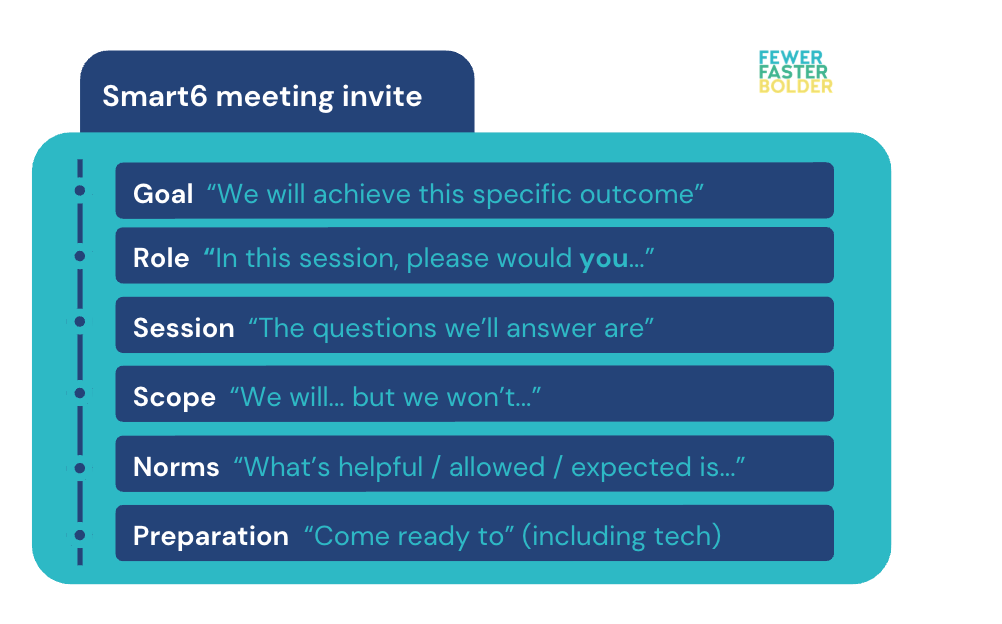
Each element deals with one of the six things that most commonly go wrong when meetings fail. In order:
Goal
What is the single outcome this meeting needs to achieve? (Not a list of topics, but just one clear result - if you can't write this, you might not be clear enough to make good use of precious meeting time yet. Very important distinction - this goal does not need to be narrow and small or reduction e.g. "Make a decision between A and B, now!". The goal can be expansive: "Reconnect after Project A and reset our team so we are ready and energised for Project B" <--- but can you see that this focused on energy and connection and doesn't limit the conversation BUT is still specific and tells people what they are coming to.
Example:
❌ "Q3 priorities" (this is a topic - we kind of hope the meaning is implied)
✅ "Agree which three projects we're prioritising for Q3 and who owns each" <--- THIS is an outcome goal
✅ "Hear what's really going on for people right now and understand the situation at hand (before we think about how to fix it)" <--- This is an outcome goal that leaves the door wide open but is still clear and specific.
Roles
What do you need, specifically, from each person? e.g. "I need your take from a due diligence POV on the potential new supplier" or "Can you come ready to tells us the story behind last month's numbers?" Yes this bit takes a bit more time but these are real human beings we're talking about. Take 1 minute to give these real humans a single line that tells them the specific job you want them to do in the 60 minutes they are dedicating to so they can think in advance if they need to and come, defences down and ready to make a fantastic contribution. As always, you can make the role wider or narrow it down. You are not boxing them in, you're trying to free them to contribute more/better/faster.
Examples:
✅ "Jo: please come ready to share what the data shows on customer churn. Sam: walk us through the options you've identified. Ravi: you've seen this kind of situation before — I want your honest feedback."
✅ "Tomás: I need you to challenge the timeline. Fatima: bring the numbers from last quarter. Ed: I want the operational risks from your perspective."
✅ "Everyone: come with one thing you'd stop doing if you could, and one thing you'd protect at all costs."
Session
This is really what would have been the list of topics in the agenda, and you can include a list of topics here if that makes most sense. The more sophisticated approach is to give the session a series of questions to answer that guide people through those topics in a more meaningful way. What are the two or three specific questions the group needs to answer together to get to that outcome? Humans are question-answering machines, and a question will immediately orientate people around the most useful conversation.
I also like to include a heads up for any structures or tech we'll be using.
Examples:
✅ A question based session plan.
1. Where are we against our plan?
2. What's the biggest risk right now?
3. What are out top priority next actions?
We'll use brainwriting (time to think and write silently) before we discuss each together.
✅ A more traditional content agenda, but with more clarity
1. Evaluate progress against the plan
2. Surface key risks (including those we are avoiding!)
3. Make a priority action list for the next 4 weeks.
We'll use a Miro board to work on this together.
Scope
What will we do and what won't we do? This is underused and underrated. Saying out loud "we're not covering X today" gives people permission to park things without feeling ignored, and it stops the meeting from being colonised by adjacent problems. I do this by having an actual (short) list of what we will do and what we won't do. It's much easier to then facilitate a session where we have already explicitly noted the things that are not going to be covered today.
Examples:
✅ "Today we're focusing on the launch plan for Q4. The brand positioning question is not on the table — that decision has been made."
✅ Or you could try this:
"Will do:
- A speedy (5min) review of Q3
- The launch plan for Q4.
Won't do:
- Any further work on the brand positioning (the decision is made and it's now off the table)
- A detailed timeline (this will be done in resource planning)
- Work on the creative brief (Anya is working on it and will share it next week)"
Norms
How do you want the group to work together in this session? We are making clear what is expected, what is allowed, what is helpful, and what is unhelpful rather than leaving people to guess. This can be a really hard one because we don't want to appear condescending or overly rigid. Some norms are hard to state out loud, like "Stop typing emails during our meetings!"
The way I do this is to think about all the bad things that might happen :-) and reframe them as positive or clear norms. Even one sentence here can elicit a much richer contribution from people e.g. "We'll hear from everyone before we reach a conclusion".
✅ "We'll hear from everyone before we reach a conclusion".
✅ "This is a short, pacey meeting so come fully focused on the session with no other tasks running so we can get to our goal and also finish on time"
✅ "Use the Hand Up button to contribute and I'll step in if anyone is talking for too long".
There are lots more of these in my new Team Collaboration Reset course (more on this coming soon!) as setting norms is such a powerful and underrated skill in most teams.
Preparation
What should people read, think about, or bring? This is the great equaliser. It gives the reflective thinkers and the introverts a chance to do their best thinking before the room fills up with the energy of whoever processes fastest out loud
Example:
✅ "Read the two-page brief. Come with your top concern and your top question."
✅ "Reflection question: if we do nothing, what does the situation look like in six months?"
✅ "Review last quarter's data and come ready to say what you think it means i.e. the specific story you take from it and the implications for our programme."
✅ "Write down your honest view before the meeting. We'll share these at the start so we can see where we agree and where we don't."
✅ "Bring one example of a time you've seen this kind of problem handled well."
Here's why it works (and how it's different from a standard agenda)
An agenda is a list of topics. The Smart6 is a briefing that sets up a group to succeed on a specific task in a tight time window - different ball game.

It's should become a norm not a tool
Great, if you like it, adapt it and use it. Much better if you can create this as a standard for a minimum viable meeting in your organisation. The best way to do this is to share it with people and encourage them to ask for it - create a pull effect for this information. If you or they receive a meeting invite with no further details, or just the agenda which doesn't give a clear briefing, then ask for that list of items. Over time, people who lead meetings will adjust and decide it's just easier to provide them because they know people are going to ask you if they don't!
If there is ONE collaboration norm you implement in your organisation, make it this one :-) As always, you can adapt for your organisation but the power is having a shared language and a shared tool that becomes a repeatable pattern that drives up collaboration quality and efficiency.
Very curious to hear your thoughts! |

 With my best wishes as always 👋